Glennkill flock’s investigation into George’s killing
Three Bags FullGlennkill flock’s investigation into George’s killing begins when the sheep refuse to treat their shepherd’s death as a human matter beyond their concern. Led by Miss Maple, they make a collective promise to identify the person who killed George Glenn. The inquiry becomes more than a search for a culprit: it forces the flock to confront the human world surrounding its pasture, and to decide whether understanding a disturbing story is worth the fear it brings.
The discovery and decision to investigate
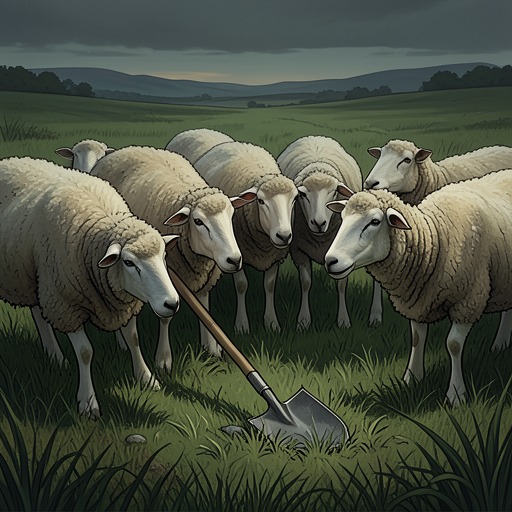
George’s body lies in the grass beside the hay barn, a crow perched on his woolly sweater and a spade protruding from him. The sheep had initially feared practical consequences—who would bring them hay?—but Miss Maple has already reasoned that neither midsummer hunger nor a wolf explains the scene. Sir Ritchfield is equally blunt: George did not die of an illness, because a spade is not an illness. The physical fact of the weapon turns a baffling absence into a crime.
Miss Maple argues that George had once looked for whoever was responsible when a fierce dog took one of their lambs. Because he was their shepherd, the flock owes him the same effort. She calls the act wolfish and identifies it as murder. Othello sharpens the question of who could have done it: in his view, the culprit must be human, or an exceptionally large monkey. His reference to his youth at Dublin Zoo supplies the experience behind the unusual comparison, but does not solve the case.
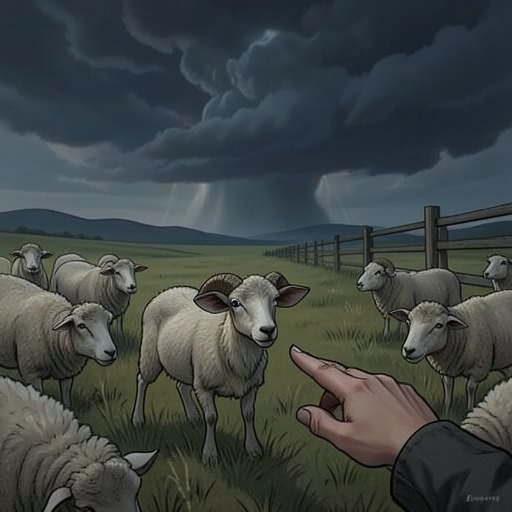
When Heather asks what should happen after they find the person responsible, Othello answers with the demand for justice. The other sheep take up the word, and George’s flock resolves to investigate for itself. Their decision is grounded in reciprocal care: George had protected them, and they will not allow the spade in his body to become an event nobody tries to explain.
Following clues through a human landscape
The first inquiry is physical and uncomfortable. Miss Maple circles George at a distance, approaches the spade, sniffs his clothes and face, and finally puts her nose into the wound. The other sheep watch from a huddle, holding their breath; she returns with blood on her muzzle. The investigation is therefore conducted not from a safe human vantage but through the flock’s own senses and the body it is trying to understand.
Everyday places and objects acquire possible evidentiary weight. Behind the hay barn, George’s caravan stands beside his fenced vegetable garden, where he had grown lettuces, peas, radishes, cress, tomatoes, endives, buttercups, and chives. After George’s death the sheep push open the garden gate and strip the beds. The raid ends in shame, but Othello, who did not join in, draws Miss Maple’s attention to the place where George’s gardening spade usually leaned. It is missing. The episode gives the absent tool a specific history and location: the flock knows it as an ordinary implement associated with the garden, even as a spade at the crime scene signifies violence.
The human community offers a more compromising explanation of George’s life. Harry the Sinner dismisses the possibility that there is no contraband in the caravan and argues that George’s small flock could not have supported him. Tom O’Malley adds an account of boats arriving on the beach at night, goods being taken to the caravan, and George driving away the next day. Their talk also recalls his hostility to tourists and developers: he had thrown sheep droppings at visitors, refused access, and fired a pistol to frighten people away. These are claims made by villagers, not a verdict established by the inquiry; they nevertheless change the apparent setting from an untouched pasture into land caught between George’s secrecy and others’ commercial ambitions.
Doubt, fear, and the urge to stop
As the questions accumulate, the investigation begins to divide the flock. Miss Maple names unresolved matters that the sheep themselves have raised: Tess’s whereabouts, the wolf’s ghost, what God was seeking in the meadow, the connection between Lilly and Kate, Ham’s presence, George’s relation to drugs, and the identity and purpose of a master hunter. She treats the questions as reasons to continue. Maude, by contrast, says the main thing is that the hunter not return; she trusts her nose to recognize him if he does. The difference is not simply between cleverness and ignorance, but between the need to know and the wish to feel safe.
Miss Maple answers the flock’s calls to stop thinking by invoking George’s story about the wolf in sheep’s clothing. Her warning is that danger cannot be dismissed merely because its explanation is frightening or unclear: either the flock finds the wolf, or the wolf finds them. She insists that a story must be followed to its end. Cloud’s quiet reply—that the flock needs a shepherd—makes the cost of Maple’s determination visible. George had supplied direction; without him, the flock must choose whether to follow its own investigator.
That tension recurs when Gabriel uses George’s scythe to cut grass. The sheep watch a human grazing: the blade passes through the meadow, leaving flattened grass behind, while Gabriel gathers it for his flock. To the sheep, the act looks like senseless destruction, even though it is grass they would ordinarily eat. The scene does not identify George’s killer, but it alters the flock’s reading of human actions and of tools. An implement associated with ordinary work can become frightening in another hand, just as the spade’s familiar place in George’s garden cannot explain how it came to be in his body.
What the inquiry brings into view
The investigation also draws out a concealed family history. One night, Rebecca reads to the sheep and then abandons her book for a tale about a girl with two fathers, one secret and one acknowledged. The secret father and daughter were fond of each other, but a quarrel kept them apart; when he wrote that he planned to travel to Europe and wanted to see her first, she concealed her joy and made him wait. He waited until he died. Presented as a story rather than a direct confession, the account nevertheless discloses Rebecca’s history with George and gives their estrangement a painful shape: he sought a meeting, and she did not answer him in time.
The flock’s inquiry thus links the immediate mystery of the missing or misused spade to larger uncertainties about George’s private life, the land, and the people who move through it. It exposes allegations of smuggling without proving them, and a family disclosure without converting it into a solution to the murder. Its clearest outcome in these episodes is a changed understanding of what the sheep have undertaken. They began by promising justice to their dead shepherd; following the questions reveals that the story they must face includes not only who killed George, but what their human relationships and apparently familiar pasture had concealed.